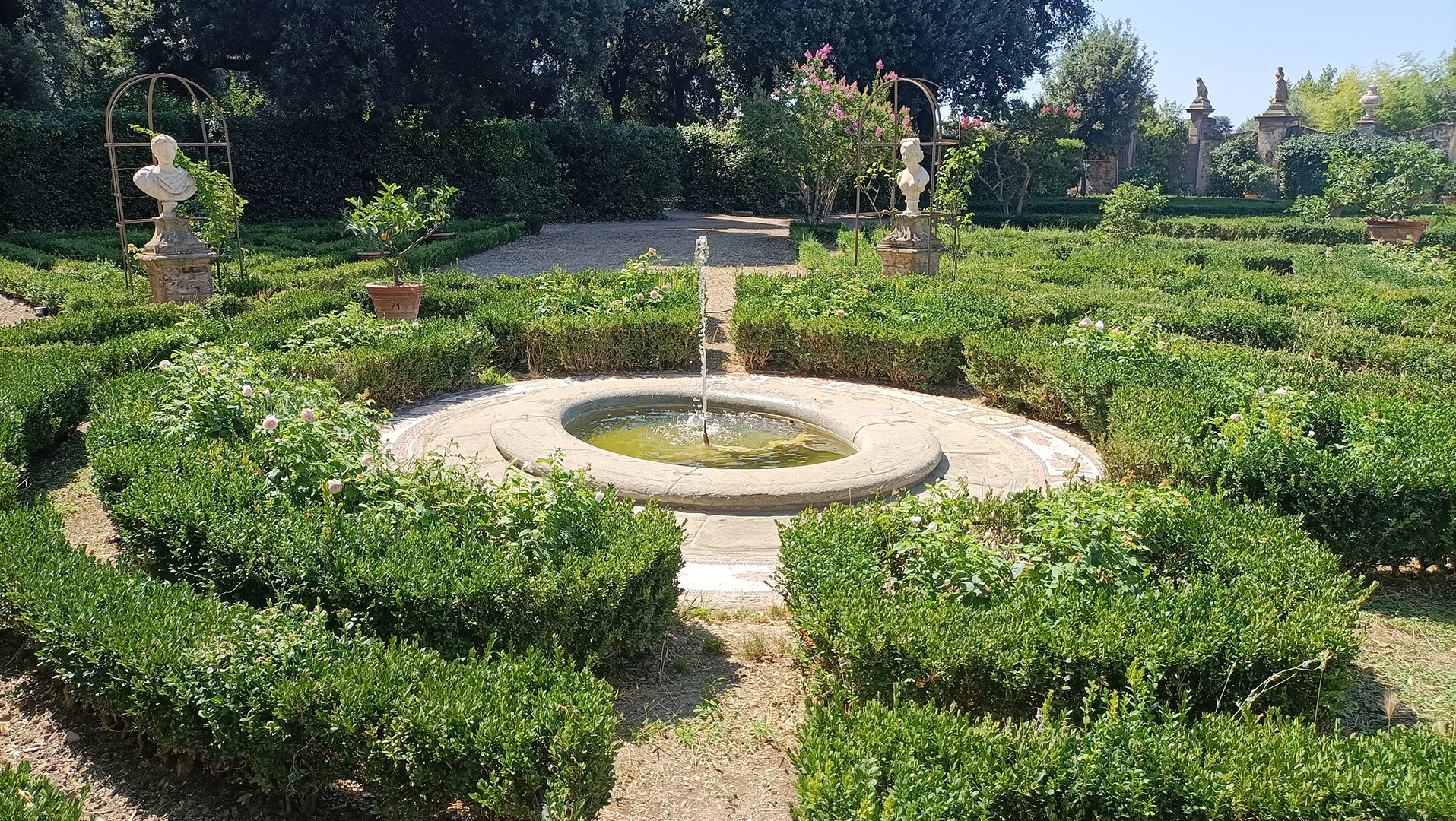
The first changes to the garden took place around the middle of the seventeenth century, when Marquis Giovanni and his brother Monsignor Lorenzo Corsi commissioned new work from Gherardo Silvani between 1627 and 1641. In addition to the Villa, the work also extensively involved the garden, which was thus considerably extended and refined, both in terms of the care devoted to the water features and the architectural layout that transformed the garden into a sumptuous theatrical scene integrated with the architectural façade of the Villa. In front of the façade, two small elliptical basins still existing today led to the new Italian garden, with rectangular flowerbeds bordered by box hedges with a small round basin in the centre. At both ends, a long fishpond and a woodland area (a grove of evergreens) were created. On the side of the fishpond, separated by a wall, a star-shaped garden was also created, enclosed on three sides by a boundary wall and on the fourth by the Lemon house. Between the fishpond and the wall of the star-shaped garden the large Cinque Fonti (Five Springs) fountain was then created.
The round parterre fountain
The round eastern fountain now forms the centre of the parterre, along the lines of the seventeenth century garden design recovered by Giulio Guicciardini Corsi Salviati in the early twentieth century. During this period, the fountain was restored to its current form, surrounding it with space and light to enhance the linear simplicity of its shape. As can also be seen in the late nineteenth century photos, in the centre of the fountain, now surmounted by an eagle, stood a bronze statue of Mercury, by Zanobi Lastricati.
The large round fountain
The creation of the large round fountain, once called the Cinque Fonti (Five springs) because of the number of its high jets of water, dates back to the alterations to the garden commissioned at the end of the seventeenth century by Antonio Corsi, son of Giovanni and therefore Monsignor Lorenzo’s nephew. Together with the long fishpond nearby, this fountain was one of the centrepieces of the complex system for managing and distributing the garden’s water, which was conveyed by long pipelines from the springs on the slopes of Monte Morello and in Colonnata. The print by Giuseppe Zocchi, dated 1744, clearly shows how the fountain was one of the garden’s major attractions. The round fountain, shown in the foreground, amazed visitors with its five water jets rising to the sky in the French fashion. The fountain was built by enlarging a pre-existing, elliptical-shaped one that surrounded a small island, called “rabbit island”, following a fashion that attempted to reproduce the ancient Roman leporarium which was the area in the garden of the patrician villa where hares were bred for the kitchens.
Loggia del Bacchino
Between 1636 and 1641, Monsignor Lorenzo Corsi, who was fond of songbirds, had a loggia built on the western side of the Villa, as an extension of the Old Gallery which he had requested, to be used as an aviary, based on a design by Gherardo Silvani. The great-grandson Antonio Corsi, fourth marquis (1685–1743) transformed the aviary into an open loggia with a statue depicting Bacchus and commissioned Ferdinando Melani to paint frescos of views of ruins on the walls. Shortly afterwards, the room was once again transformed and became Café Haus enclosed by a glass wall, which remained until the early twentieth century.
The statue of the “Bacchino”
Thus, Monsignor Lorenzo’s aviary was transformed into a recreational loggia opening onto the beautiful garden at the behest of Antonio, who also had the fountain made that we still see today. It was then that a valuable statue from the Corsi collection, until then kept in a room of the villa, was moved to the loggia. This was the Satiro che spreme le uve (Satyr squeezing grapes), created in 1595 by Pietro Bernini (born in Sesto and father of Gian Lorenzo). The figure of the satyr, engaged in squeezing a bunch of grapes, was mistaken for that of Bacchus, the god of wine, and that is why the loggia was soon called “del Bacchino”. Since 1883, the original of the statue has been kept in a museum in Berlin.
The long pond
In the long pond, or fish pond, the water was in perpetual movement. Excess water, which was not used for irrigation, flowed in, and water that fed the canal of the ragnaia flowed out (today, to avoid any possible waste, there is a recirculation system and water only occasionally flows into the ragnaia). Built immediately at the beginning of the alterations to the garden under the direction of Gherardo Silvani, in 1732 it was adorned at the four corners with statues of the Seasons, works by Girolamo Ticciati, a sculptor who was very active in Florence at the time (he was responsible for the grandiose Baroque altar in the Baptistery). The theme chosen for the four statues makes clear reference to the cyclical nature of the life of the garden and the activities connected with cultivation, both inside and outside the park, as in the many agricultural estates around the Villa, which acted as the real management centre of the vast farm. Unfortunately, one of the statues was destroyed during the bombing of the Second World War.
The statues of the boundary wall
Antonio di Giovanni Corsi was the creator of extensive work on the Villa and the garden, which he filled with dozens of sculptures, mainly relying on the work of Girolamo Ticciati, who was active between 1732 and 1736 and produced works in sandstone. A very different kind of subject is depicted on the western wall next to the Lemon House compared to the statues on the wall separating the garden from the countryside. While the first statues, some now reduced to fragments, represent ancient divinities and heroes of classical times (Diana, Apollo, Venus, Juno, Hercules), chosen because some of their stories can be traced back to the theme of water, on the boundary facing the fields the wall is populated only by rural characters, both male and female peasants (the Villani), whose poses and activities are related to the changing of the Seasons, which are depicted in the four large statues surrounding the long pond.
The ragnaia
The ragnaia derives its name from the ragne which are the tightly woven nets placed over the pruned forest walls, often parallel to a waterway, which attracted small birds with its gurgling sound. This hunting technique was called birding. In 1751–52 a 350-metre-long artificial brick channel was inserted into the Villa’s original ragnaia, which extended from the southern boundary wall next to the Lemon House, fed by runoff water from the garden’s long pool. The water spurts out from a central jet and from the spouts of two stone dolphins on the sides, and the channel is divided by thirteen sluices that generate as many waterfalls. On either side of the channel, two internal pedestrian paths, complete with stone seats and obelisks, allowed people to enjoy the “delights” of shade and coolness even on the hottest days. In 1962, the ragnaia was cut in two to create a new road to facilitate access to the centre of Sesto Fiorentino. The part closest to the Villa remained the property of the Counts Guicciardini Corsi Salviati, while the other became public.