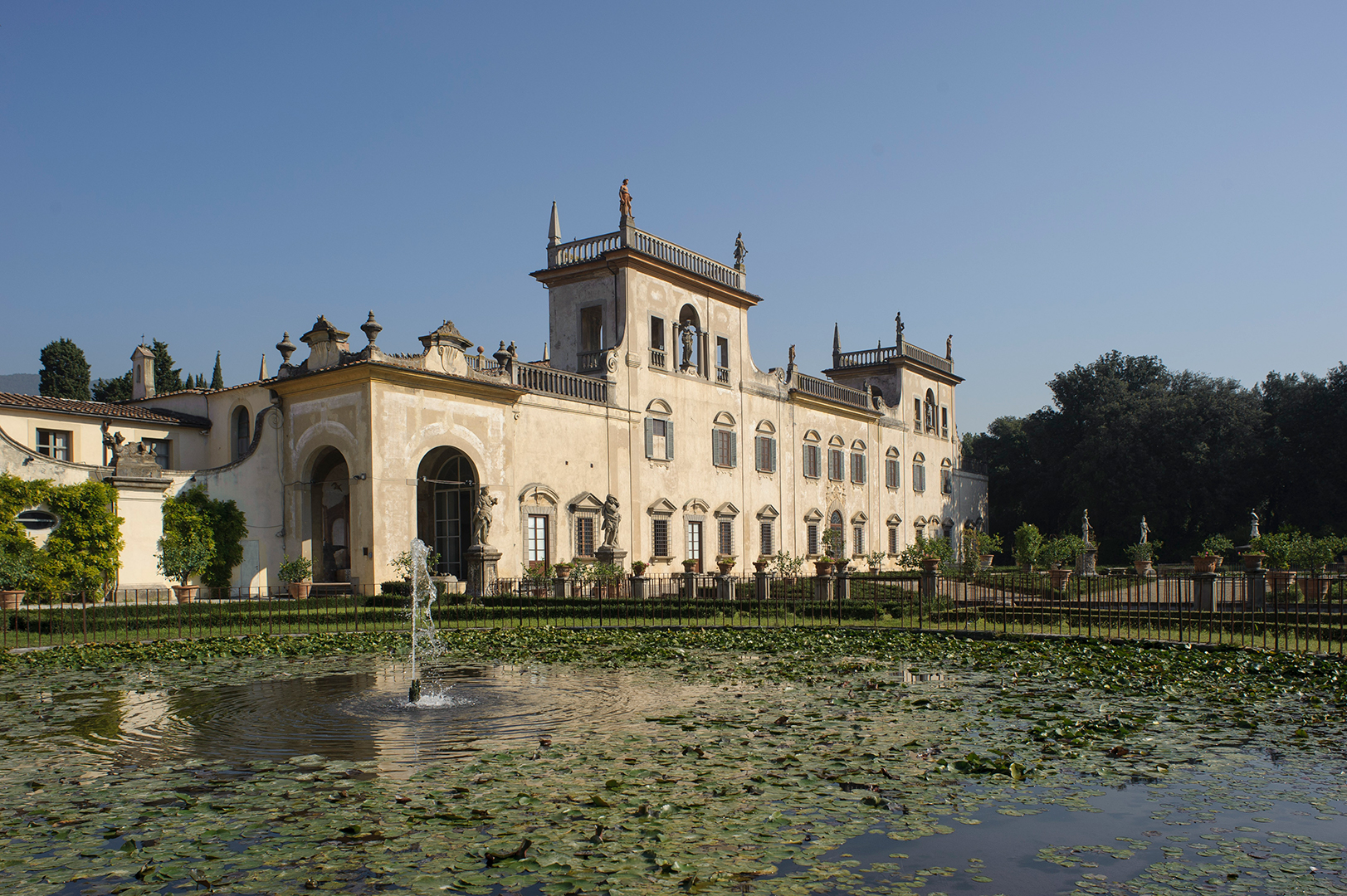
It was in this century that the “manor house” started to undergo major changes. In 1615, Bardo Corsi (1566–1624) bought the Neapolitan fiefdom of Caiazzo and the family finally obtained the noble title of marquis. It was Giovanni (1600–1661), with his brother Monsignor Lorenzo (1601–1656), who would later invest considerable sums in the house and garden at Sesto, profoundly altering its appearance, enlarging it and transforming it from a sixteenth century dwelling into a luxurious villa, in keeping with the high social standing and considerable wealth now attained by the family. For this reason, many rooms were added to the main building at this time: reception rooms on the ground floor, bedrooms, as well as kitchens, pantries, a stable, a cellar, a room for the equerries and even a laundry room. These and other subsequent projects were carried out under the direction of Gherardo Silvani, a leading figure in the civil and religious architecture of this period in Florence and the villas in the surrounding area. The architect succeeded in giving the Villa a new harmony, visually stitching together the old structure with the new additions, creating a new unified façade on both the main road and the garden. One of the alterations made by Silvani was also to “multiply” the old tower, building three more at the corners of the building.
The Old Gallery
Monsignor Lorenzo Corsi, who was behind the seventeenth century works at the Villa together with his brother Giovanni, was a cultured prelate and refined collector. He was twice Ambassador Extraordinary to Grand Duke Ferdinand I: in 1638, for the birth of Louis XIV, and in 1642 for the death of Maria de’ Medici. Senior major-domo to Cardinal Carlo dei Medici, then apostolic nuncio to France and finally papal legate in Avignon. He had his own private apartment in the Villa decorated and frescoed, and he also commissioned the ground floor gallery adjacent to the western side, now called the “Galleria vecchia” (Old Gallery). The prelate had appointed an important painter of the time, Baccio del Bianco, to decorate it between 1640 and 1641, but unfortunately nothing remains of these decorations. To complete the gallery, he also had an aviary built in the garden, today known as the Loggia del Bacchino. Aviaries are not unusual in suburban villas, but in this case we know that Monsignor Lorenzo had a special passion for songbirds.