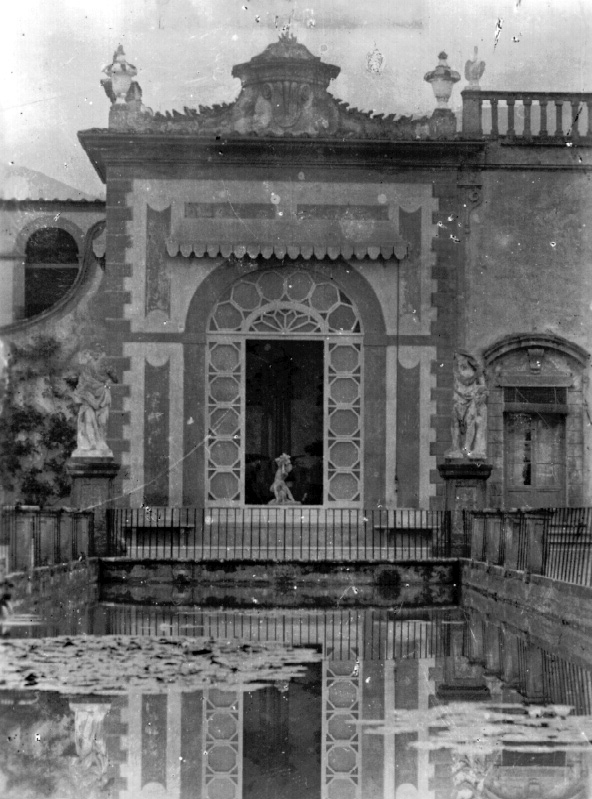
Marquis Francesco Antonio Corsi Salviati (1814–1878) was the first to introduce the first exotic plants into the extensive garden, again following a fashion that was becoming increasingly popular throughout Europe. It was in order to ensure the survival of some of these rare plants, among which were numerous palms and cycads, that Francesco Antonio and later his son Bardo had two greenhouses built that were heated by steam stoves (with an English brand of boiler), the height of modernity and opulence. The passion for rare and exotic botany was inherited by his son Bardo (1844-1907), who from 1866 initiated a large-scale project to enrich the exotic species cultivated by his father and to increase the number of ornamental plants. Bardo Corsi Salviati’s garden was a veritable plant library, famous both at home and throughout Europe, which went hand in hand with his huge library full of English-language volumes, with which Bardo had been educated. This passion for the exotic displayed by the two Corsi marquises had, however, distorted the garden’s original baroque appearance.
The Grand Duke’s Mugherino (Jasmine)
One of the most extraordinary rarities found in the Medici grand ducal gardens was the so-called Mugherino, a special double jasmine from Goa that was very fragrant, which only the Medici possessed and which they kept a close secret. Francesco Redi, the Grand Duke’s archiater (chief physician) and a scientist and pupil of Galileo, invented a recipe for Cosimo III, who was a chocolate lover, that remained a “state secret” for a long time and was highly regarded in all European courts. The delicacy, which could only be tasted at court, was jasmine chocolate made by slowly flavouring the cocoa powder for at least 10 days by placing it in tin boxes with jasmine flowers, which were changed every day. The Corsi family came into possession of the Medici Mugherino in the nineteenth century, and specimens of this Indian jasmine with double, white, fragrant flowers resembling gardenia buds were cultivated under the Loggia del Bacchino.
The Ragionieri, the history of a family of gardeners
The family history of the Ragionieri family is interwoven with that of the marquises Corsi Salviati, particularly in the years from the mid-nineteenth century to the first half of the twentieth century, in what was perhaps the most prolific and prosperous period for plant cultivation at the villa, decisively boosted by Bardo Corsi Salviati. In fact, Bardo elevated the garden, greenhouses and acclimatisation nurseries that housed special types of plants, the results of interesting experiments and constant imports from tropical countries, to international fame. From 1866, Bardo, with Rodolfo Ragionieri as head gardener, set up a huge project to enrich exotic species and increase the number of ornamental and commercial plants, including the Roselline di Firenze (Florentine little roses), the true pride of Corsi, which Attilio Ragionieri then raised to the highest quality. Attilio Ragionieri, a physician and hybridist, was born in 1856 to Rodolfo Leopoldo, who had worked in the Corsi Salviati garden from 1844 to 1892. He was descended from a family of skilled gardeners, as his paternal grandfather Giovanni Ragionieri, who had been the director of the grand ducal garden of Castello from 1822 to 1858, was in turn the nephew and adopted son of Gaetano Gheri, who had held this position from 1790 to 1822, then bequeathed it to him. Attilio’s younger brother Eugenio would be the last of the Ragionieri to work at the Villa, working there until 1951.