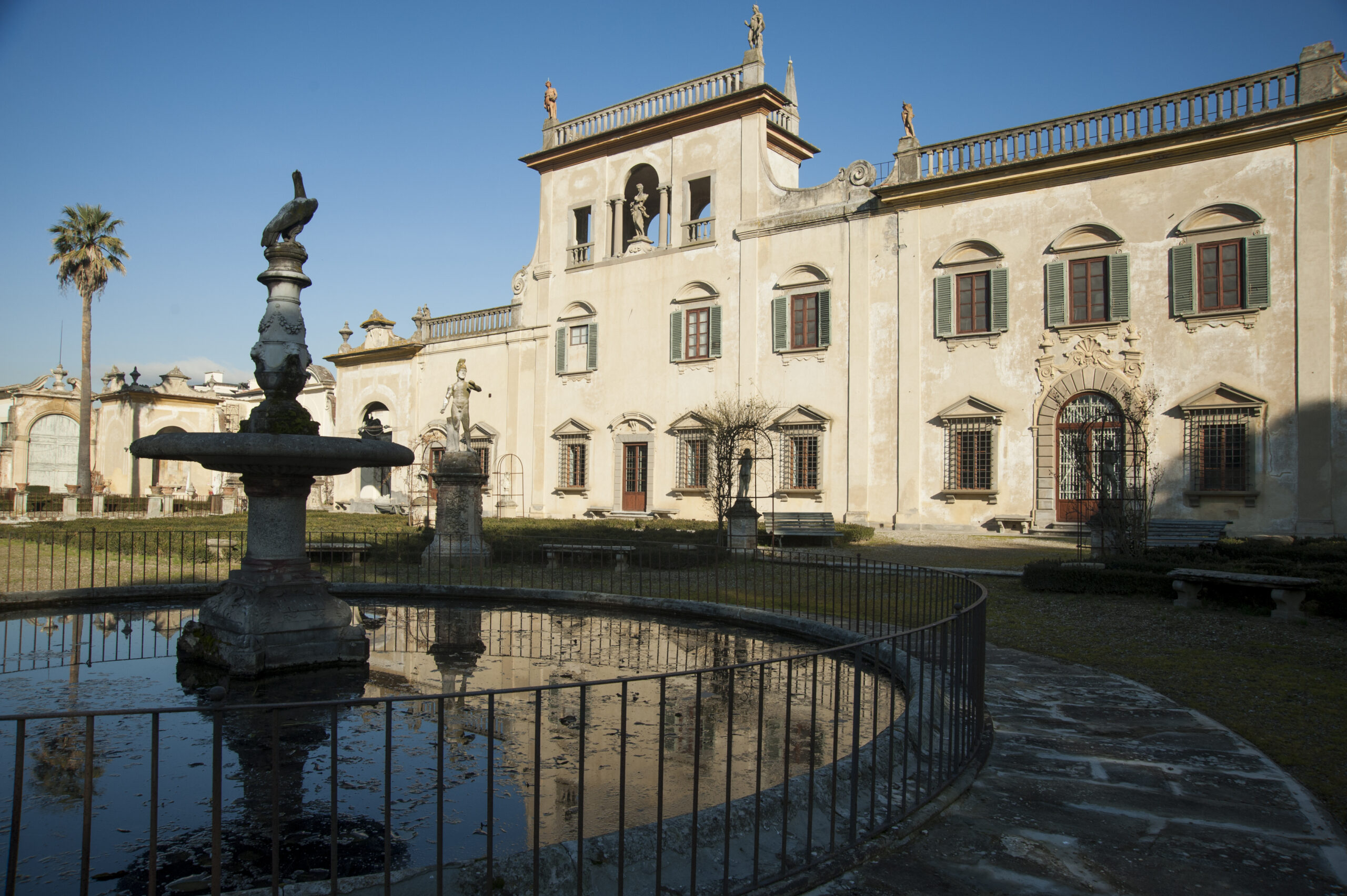
In the first half of the nineteenth century, financial difficulties began for the Corsi Salviati family, as for other ancient Florentine descendants, also linked to the political and economic changes affecting the Grand Duchy. The Corsi family, although possessing solid property holdings, thus found themselves for the first time needing to sell part of their many assets. They did not, however, give up the Villa and the estate at Sesto, but rather than expanding the land estates as their ancestors had done in the previous three centuries, they began disposing of part of the agricultural assets. In the main buildings, the focus was mostly on “modernisation” and maintenance. These were the years in which Amerigo began the modifications to the garden and created a “stove” in the east gallery. The only significant architectural intervention was carried out by Francesco Antonio Corsi Salviati, son of Amerigo, who in 1845 commissioned the Florentine architect Telemaco Buonaiuti to enlarge the chapel of San Leonardo, in memory of his wife Francesca Reader who was buried there. With the death of Bardo Corsi Salviati in 1907, the family died out. His only daughter, Francesca, had married Count Lodovico Guicciardini, and their son Giulio became the sole heir of the Corsi Salviati family.
Nineteenth-century decorations. The three rooms on the first floor
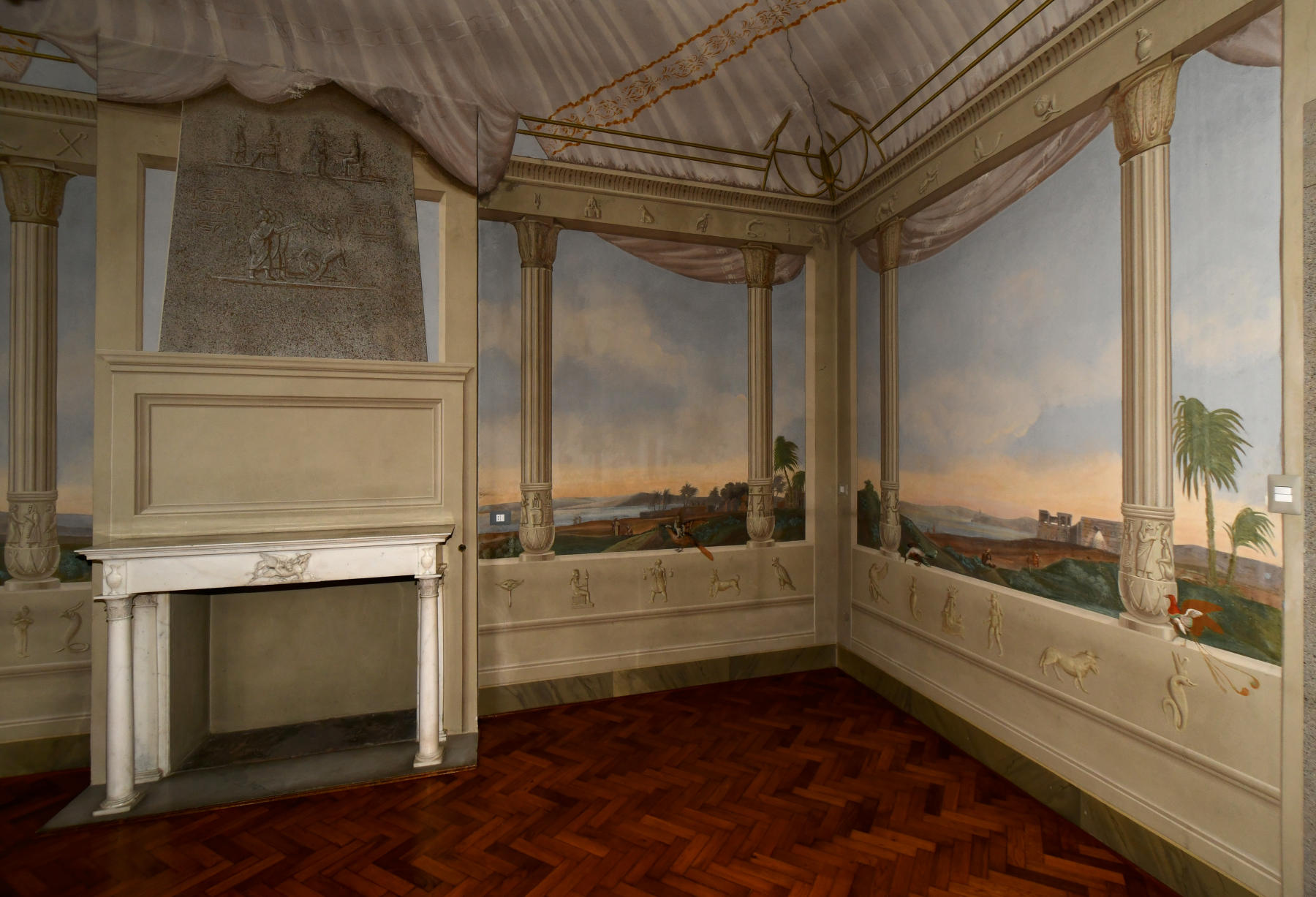
With the exception of the sixteenth century Camerino delle Grottesche, the main decorations of the Villa at Sesto can be traced back to the nineteenth century in two distinct phases, the first in the early 1910s, at the time of French domination, and the second in 1864–66, at the time when Florence was the capital city. Thus, two crucial historical and political moments for Florence and its territories. Dating from the first phase are three rooms on the first floor, the “salotto dipinto a bosco” (woodland parlour), the adjoining “sala del caminetto” (fireplace room) and the “stanza di Giove e Ebe” (Jupiter and Hebe’s room). The first two are characterized by the same trompe-l’oeil effect with the walls breaking through wooded and rural landscapes. The “sala del caminetto”, on the other hand, is decorated with Egyptian elements, which became fashionable in Europe after Napoleon’s Egyptian Campaign. The third room is frescoed in a neo-Pompeian style, also fashionable at the time. These rooms were probably decorated on the occasion of Amerigo Corsi’s wedding to his cousin Giulia in perhaps 1813 and show how the hosts’ taste was perfectly aligned with the most up-to-date European trends. Antonio Corsi Salviati, the patron of these rooms, held prestigious public offices and was a Florentine figure with close ties to Napoleonic France.
The salon on the ground floor
Immediately after the unification of Italy, at the time when Florence was chosen as the new capital of the Kingdom, Marquis Francesco Antonio Corsi Salviati commissioned the work of the patriot painter Eugenio Agneni to completely redecorate the large ground-floor salon. Again, as with the rooms on the first floor, the occasion was almost certainly a marriage, in this case of Francesco Antonio’s son, Bardo, to Pia Tolomei in 1865. The complex iconographic design proclaims the power of love that transcends time, and of the life-giving force of the four elements depicted on the walls. It is a complex decoration on the ceiling with a masterful architectural background in a classical style that is the basis of the attempt to create a new style for the new realm.
Giulio Guicciardini Corsi Salviati
Giulio, the heir to the estate of so many Florentine families, was deeply attached to the Villa at Sesto, where the family continued to stay periodically. He made an in-depth study of the history of the buildings and garden in the private archive, which he then published in 1937. This important research is the premise and support for the challenging renovation of the exterior spaces and the faithful restoration of some of the Villa’s rooms, which had been changed but not compromised by nineteenth century interventions. More extensive modifications were carried out in these years in the areas destined for agricultural use, in order to adapt them to changing uses and needs, investing just as much in them as in the buildings of the manor house.