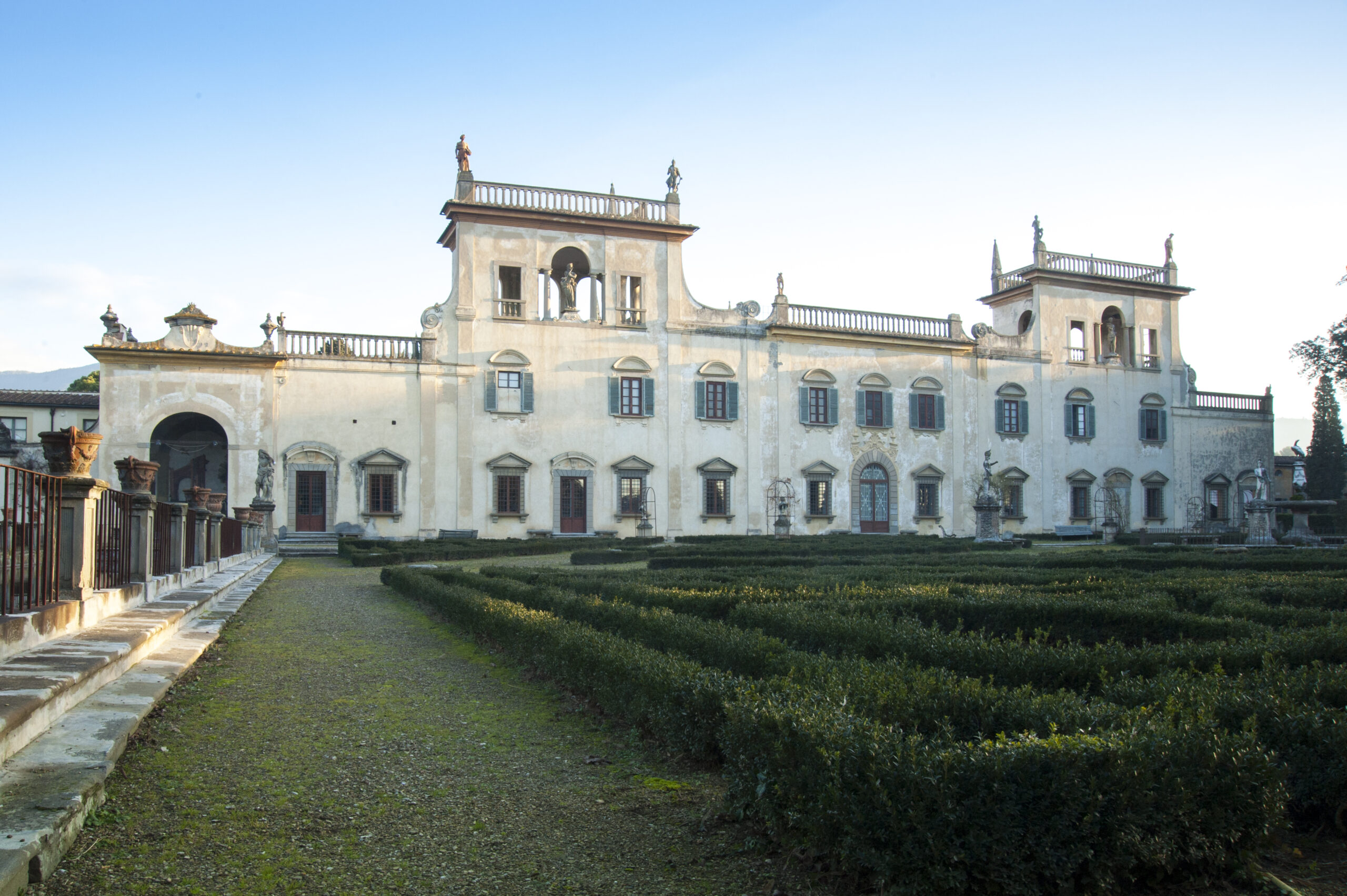
From the sixteenth century, one of the main concerns the Corsi family had with this property was to ensure an adequate water supply for the Villa, the garden and the fields. This continued to be the case in the eighteenth century, especially in view of the modifications to the building and the garden. From 1729 onwards, when Marquis Giovanni died and was succeeded by his son Antonio, important modifications began that would give the Villa the appearance that we know today. The architects summoned for this new phase were once again chosen from among the best of the time: Pietro Paolo Giovannozzi, whom the Electress Palatinate had used at her Villa La Quiete, and then Ferdinando Ruggeri, who had built the bell tower of San Lorenzo in Florence, also commissioned by the Electress. Ruggeri was the real director of this phase, when the large Lemon House, now a theatre, was built, and the wall next to it was decorated with statues and sponges. The two façades of the Villa, the outer one facing the main road and the inner one facing the garden, were redesigned by Ruggeri with elegant Baroque forms. Silvani’s four crenelated towers became terraced, decorated with urns and statues, and the side facing the garden was opened up with elegant Venetian windows. These works definitively shaped the new appearance of the Villa, no longer a semi-fortified settlement but a pleasant place of leisure, emphasised by the lightness and brightness of the façades.
The façades
The two main façades of the Villa were redesigned by Ruggeri in the first half of the eighteenth century. The one on the inside overlooking the garden was enlarged and further emphasised horizontally by the incorporation into the overall decoration of the Villa of the two aviaries and the back wall connecting them, decorated with urns, pinnacles with sponge-like decorations and elegantly curved mouldings. On the main road, however, Ruggeri chose to emphasise the verticality of the central part, clearly distinct from the lateral parts, marking the central axis with the main door surmounted by the imposing coat of arms, and ending in the balustraded attic providing a pure theatrical backdrop, and in the obelisks pointing straight up to the sky.
The second aviary
On the short side of the Lemon house overlooking the garden, Ruggeri made a second and smaller aviary, modelled on the one made by Monsignor Lorenzo and placed in symmetry with it. The new aviary, home to turtle doves on its inauguration, was frescoed with views of ruins and birds. On that occasion, the painter Ferdinando Melani also redecorated the seventeenth century aviary opposite.